
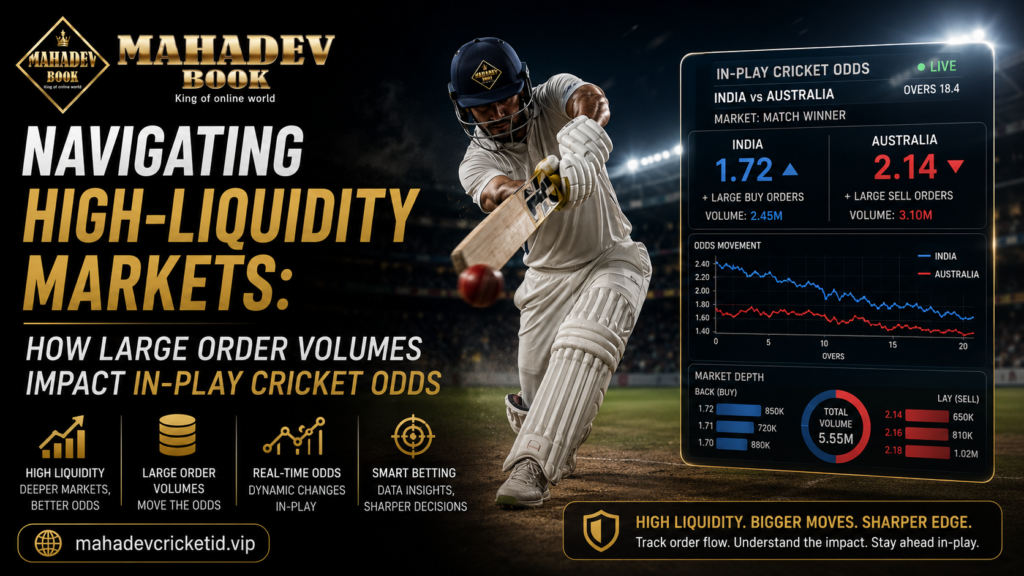
Not every cricket match gets priced the same way behind the scenes. A marquee IPL final and a lightly-attended domestic fixture can carry identical-looking cricket odds on screen, yet behave completely differently the moment real money starts moving through them. High-liquidity betting markets explained simply: liquidity measures how much money is actively being matched at a given price, and it changes almost everything about how an odds movement should be read.
What Liquidity Actually Means on an Exchange
On an exchange, liquidity refers to the volume of matched and available orders sitting at each price point. A high-liquidity market has deep order books — lots of users backing and laying at prices close together, ready to be matched instantly. A low-liquidity market has thin order books, with gaps between available prices and less volume ready to absorb a large bet without shifting the price significantly.
How Order Volume Actually Moves a Price
How order volume affects cricket odds comes down to a fairly intuitive mechanic once you see it laid out: a price only moves when the volume available at the current level gets used up. In a deep, liquid market, a large order gets absorbed by the depth of orders already sitting there, and the price barely moves. In a thin market, that same order can eat through the available volume at several price levels in sequence, causing a visibly sharp jump.
This is why the exact same size bet can have wildly different effects depending on which match, and even which specific market within that match, it’s placed on.
Why Marquee Matches Behave Differently From Smaller Fixtures
High-profile matches attract far more participants, which naturally deepens the order book and makes the market more resistant to being moved by any single large order.
Niche or lower-profile fixtures see thinner order books, meaning even moderately sized bets can shift the price more noticeably than the same amount would in a marquee match.
Specific market types within the same match can have very different liquidity — the match-winner market is typically far deeper than a niche session or player-prop market on the same game.
Reading a Price Movement in Context of Liquidity
Market liquidity on a cricket exchange is the missing context behind most price movements that look confusing at first glance. A price that jumps sharply in a low-liquidity market might reflect nothing more than a single large order clearing thin depth — not necessarily new information about the match itself. The same jump in a high-liquidity market is a much stronger signal, since it would have taken considerably more volume, and therefore more collective conviction, to move the price that far.
Why This Matters More In-Play Than Pre-Match
Liquidity conditions can shift meaningfully once a match goes live. A market that was reasonably deep pre-match can thin out during a lull in play, then deepen sharply again around a key moment (a wicket, a required-rate shift) as participants rush back in. Reading an in-play price movement well means being aware that the depth behind that price isn’t constant throughout the match — it’s shifting alongside how much attention and money is actively engaged at any given moment.
The Bottom Line
A price by itself only tells part of the story. The depth of the market behind that price — how much volume it would take to move it — tells you how much weight to actually put on a given movement. A sharp jump in a thin market and the same jump in a deep one aren’t carrying the same information, even though they look identical on screen.
Frequently Asked Questions
What does liquidity mean on a betting exchange?
It refers to the volume of matched and available orders at each price point — high liquidity means deep order books that can absorb large bets without much price movement, while low liquidity means thinner books that shift more easily.
Why does the same size bet affect different matches differently?
Because marquee matches typically attract more participants and deeper order books, making them more resistant to price movement from any single order compared to lower-profile fixtures.
Does a sharp price movement always mean something significant happened in the match?
Not necessarily. In a low-liquidity market, a sharp move can simply reflect a single large order clearing thin depth, rather than new information about the game itself.
Does liquidity stay constant throughout a match?
No. Liquidity can thin out during quieter passages of play and deepen again around key moments, meaning the same price movement can carry different weight at different points in a match.
This article is for informational and educational purposes only and does not constitute betting advice.
 Get WhatsApp ID Now