

Introduction
Cricket is no longer just a sport played on a 22-yard pitch — it is an experience shaped by technology, statistics, and constant digital interaction. Over the years, the way fans engage with cricket has transformed dramatically. What once began as listening to radio commentary or gathering around a television has now evolved into real-time tracking, analytical discussions, and predictive involvement. In this new era of interactive fandom, the term Cricket Book ID has emerged as part of the modern cricket vocabulary.
But beyond its surface meaning, Cricket Book ID represents something deeper — a shift in how people connect with the game. Today’s cricket follower does more than cheer for boundaries and wickets. They analyze pitch behavior, calculate required run rates, study player form, and anticipate turning points before they happen. The game is no longer confined to the stadium; it lives in smartphones, group chats, and constant notifications.
This article does not focus on technical instructions or promotional angles. Instead, it explores the cultural and psychological transformation behind the concept of Cricket Book ID. Why has cricket fandom become more analytical? Why do fans feel more personally invested in outcomes than ever before? And how has digital participation changed the emotional experience of watching a match?
As cricket continues to evolve, so does its audience. Understanding this evolution helps us see the bigger picture — that modern cricket is not just about runs and wickets, but about decision-making, anticipation, and the powerful human desire to predict the unpredictable.
Cricket: From Radio Commentary to Real-Time Obsession
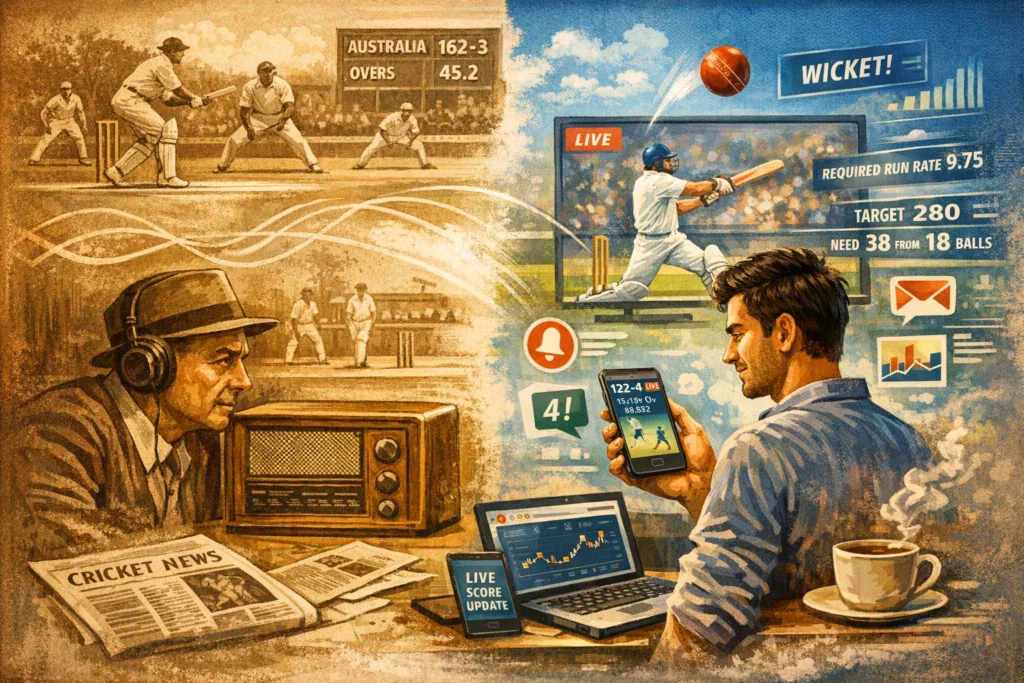
Before understanding the deeper meaning behind Cricket Book ID culture, it is important to see how cricket consumption itself evolved. The relationship between the fan and the game has never stayed the same — it has adapted with every technological shift. Each era didn’t replace the previous one; it layered new behavior on top of old emotions.
The Imagination Era – Radio Cricket
There was a time when cricket existed only in words.
Families gathered around a radio. The commentator’s voice painted the field —
“short mid-wicket”, “fine leg”, “cover drive through the gap”.
Listeners built the match inside their minds.
Every fan imagined a different stadium, a different shot, a different atmosphere.
In this phase:
- Cricket was storytelling
- Patience was natural
- Waiting was part of excitement
No visuals meant maximum imagination. The mind was the screen.
The Television Era – Visual Heroes
Then television arrived and changed everything.
Players stopped being voices and became personalities.
Children copied batting stances in front of mirrors. Posters filled bedrooms. Heroes were now visible — and therefore more emotional.
Cricket shifted from imagination to attachment.
Now fans didn’t just follow the game; they followed individuals:
- Favorite batsman
- Favorite bowler
- Favorite team
Victory felt personal. Defeat felt painful.
The fan was still a spectator — but a deeply invested one.
The Internet Era – Information Cricket
The next revolution didn’t happen in stadiums.
It happened in pockets.
Websites and live score apps introduced ball-by-ball updates. Suddenly, you didn’t need a television to stay connected. A student in class, an employee in a meeting, or a traveler in a bus could track every delivery.
This era created analytical fans.
People started noticing:
- Strike rates
- Wagon wheels
- Partnerships
- Run rate graphs
Cricket discussions became smarter. Opinions began using numbers. Arguments used statistics instead of just emotions.
The viewer became a part-time analyst.
The Participation Era – Interactive Cricket
Today we live in the fourth phase — the participation era.
Fans no longer wait for results.
They anticipate them.
They don’t just watch a captain’s decision.
They predict it.
They don’t just react to turning points.
They expect them before they happen.
This is the environment where the concept of Cricket Book ID appears — not as a sudden invention, but as a natural outcome of evolving engagement. Technology has reduced the distance between the match and the mind of the fan.
Cricket is no longer only consumed.
It is mentally played alongside the players.
The Real Transformation
Across these four eras, one pattern is clear:
The fan moved closer to the game every decade.
Radio → imagined cricket
TV → watched cricket
Internet → analyzed cricket
Digital interaction → participated cricket
The pitch is still 22 yards long.
But psychologically, it now extends into every viewer’s thinking process.
And this closeness is what sets the foundation for understanding why modern cricket engagement feels stronger, faster, and more personal than ever before.
What the Concept Really Represents
In modern digital cricket culture, the phrase Cricket Book ID appears frequently in conversations, communities, and discussions around interactive match following. But beyond the surface level, the idea of a Cricket Book ID represents a psychological shift in how fans relate to uncertainty in cricket.
Earlier, a fan watched the match and accepted whatever happened on the field. Today, a Cricket Book ID symbolizes a fan mentally stepping inside the match situation. The viewer is no longer only observing — the viewer is continuously evaluating. Every over, every field change, every bowling variation becomes a point of interpretation.
The popularity of the Cricket Book ID concept is directly connected to cricket’s unpredictable nature. Cricket is not a straight-line sport. A set batsman can get out to a simple delivery. A tail-ender can hit consecutive boundaries. A slow pitch can suddenly start assisting pace. Because of this uncertainty, fans naturally search for patterns, and the Cricket Book ID culture grows from that search for patterns.
When a fan follows a match normally, emotion is simple:
team wins → happiness
team loses → disappointment
But with a Cricket Book ID mindset, the emotional process changes:
expectation → anticipation → tension → outcome → self-analysis
Now the focus is not only the team’s performance but also the accuracy of the fan’s own judgement. This turns cricket into a thinking activity rather than just a viewing activity.
Control Over Uncertainty
Humans are uncomfortable with randomness. Cricket produces randomness constantly — edges, misfields, unexpected partnerships, sudden collapses. The Cricket Book ID idea gives followers a sense of involvement in that randomness. It creates a feeling that outcomes can be understood, interpreted, and mentally predicted.
A fan starts noticing micro-factors:
- batting intent in powerplay
- bowler confidence after a boundary
- captain’s field placement signals
- required run rate pressure
- scoreboard psychology
Each observation strengthens the belief that the match flow can be anticipated. The Cricket Book ID environment thrives on this belief. Whether predictions are correct or incorrect is secondary — the engagement itself becomes the attraction.
The Brain’s Feedback Loop
The Cricket Book ID experience works on a mental loop:
prediction → ball outcome → mental reaction → next prediction
Because cricket pauses after every ball, the brain gets repeated opportunities to test expectations. This continuous feedback makes involvement deeper than passive watching. Instead of waiting hours for a result, the mind processes results every few seconds.
That repeated cycle builds attachment.
Attachment builds attention.
Attention builds habit.
And habit explains why Cricket Book ID discussions stay active throughout entire matches, not just at dramatic moments.
Memory and Perceived Expertise
Another reason the Cricket Book ID concept feels powerful is selective memory. People remember correct expectations more than incorrect ones. If a viewer anticipates a wicket once and it happens, that moment becomes strong reinforcement.
Gradually, the fan feels they “understand match flow”.
In reality, cricket still contains uncontrollable elements — pitch cracks, ball condition, communication errors, nerves — but the brain converts occasional accuracy into perceived mastery. This perceived mastery keeps engagement continuous.
Cricket Becomes a Mental Contest
At this stage, the match is played in two parallel arenas:
- Players competing on the ground
- Viewers competing with probability in their minds
The Cricket Book ID idea exists in the second arena. It transforms cricket from a one-way entertainment medium into an interactive thinking experience. The scoreboard becomes not just information, but a puzzle.
The bowler runs in.
The viewer anticipates length.
The ball lands.
The mind reacts instantly.
This mental participation explains why modern cricket engagement feels more intense than traditional viewing. The fan is no longer distant from the match — the fan is cognitively invested in every delivery.
In essence, Cricket Book ID is less about access and more about perception. It represents the human urge to interpret uncertainty, to stay mentally ahead of events, and to feel connected to outcomes before they officially occur.
Why Numbers Intensify Emotion
The rise of the Cricket Book ID mindset has changed one major aspect of cricket viewing — emotion is no longer triggered only by loyalty, but also by calculation. In traditional fandom, feelings were attached to the team. In modern engagement, feelings are attached to expectations.
Earlier, a fan wanted their team to win.
Now, within the Cricket Book ID culture, a fan also wants their reading of the match to be correct.
This subtle shift dramatically increases emotional intensity.
From Reaction to Anticipation
A normal viewer reacts after an event.
A Cricket Book ID–oriented viewer reacts before an event.
They continuously think:
- Will the captain bring spin now?
- Will the batter slow down near a milestone?
- Will the required run rate create panic?
- Will a boundary change the field placement?
Because the brain predicts first and confirms later, every ball carries emotional weight even before it is bowled. The excitement doesn’t wait for action — it starts during anticipation.
This is why modern followers feel the match is faster and more stressful even when the format hasn’t changed.
The Scoreboard Becomes Personal
In classic viewing, the scoreboard belongs to the match.
In Cricket Book ID thinking, the scoreboard also belongs to the viewer’s judgement.
If an over goes exactly as expected, satisfaction appears instantly.
If it goes differently, frustration appears instantly.
So instead of cheering only boundaries and wickets, the mind reacts to accuracy and inaccuracy of its own expectations.
The emotional triggers multiply:
- Correct expectation → confidence
- Unexpected event → tension
- Sudden collapse → shock
- Recovery partnership → mental recalculation
The match is no longer a single storyline.
It becomes hundreds of tiny decision confirmations.
Continuous Mental Engagement
Cricket naturally pauses after every delivery. This structure fits perfectly with prediction-based engagement. Each ball offers a fresh scenario, and the Cricket Book ID mindset resets repeatedly.
The brain receives rapid feedback cycles:
observe → expect → compare → adjust
Because the cycle repeats dozens of times per hour, attention rarely drops. Even quiet overs feel active internally. A dot ball can carry as much mental reaction as a boundary because it affects expected match flow.
This is why some viewers feel exhausted after a close match — they weren’t just watching; they were constantly evaluating.
Emotion Becomes Analytical
Interestingly, emotion does not disappear in this process — it evolves. Instead of raw cheering, emotion mixes with logic.
A fan may celebrate not only because a wicket fell, but because it happened when they anticipated pressure.
The joy comes from alignment between reality and expectation.
Over time, the brain starts valuing “being right” almost as much as “team winning”. The Cricket Book ID environment strengthens this analytical emotion, making cricket feel more interactive and intellectually engaging than before.
The New Kind of Attachment
This form of involvement creates a deeper bond with the match. Even neutral games become interesting because the engagement comes from prediction rather than loyalty.
You no longer need to support a team to feel invested.
You only need to follow the unfolding situation.
That is the real transformation — cricket stops being only a sport you support and becomes a scenario you continuously interpret.
And once interpretation begins, every delivery matters — not just to the players, but to the mind following them.
The Shift from Loyalty to Analysis

For decades, cricket fandom was built almost entirely on loyalty. You supported a team because of geography, family tradition, or a favorite player. The relationship was emotional and stable — it did not depend on conditions, form, or probability. Win or lose, support stayed the same.
But the environment around cricket has changed. With the spread of digital discussion spaces and real-time data, the Cricket Book ID mindset has encouraged followers to think less like supporters and more like observers of patterns. The modern fan still cares about teams, but now also cares about situations.
Earlier: Identity-Based Support
In traditional viewing:
- A fan chose a team
- The team’s result decided mood
- Analysis came after the match
- Emotion came first, logic later
Conversations were simple and personal:
“Great innings” or “Poor bowling today”.
The connection was human and narrative-driven. The match felt like a story unfolding.
Now: Situation-Based Thinking
Within the Cricket Book ID culture, the fan’s attention shifts from who is playing to what is happening right now.
Instead of only supporting, the viewer evaluates:
- pitch behavior in middle overs
- field placement logic
- pressure phases in chase
- matchups between batter and bowler
A person may still support a team, but during the match they temporarily detach and analyze scenarios. For a few overs, they stop being a supporter and become a strategist in their own mind.
This does not reduce emotion — it changes its direction.
Neutral Matches Become Interesting
One of the biggest effects of analytical engagement is that even a match without a favorite team becomes compelling. The attraction shifts from loyalty to unfolding probability.
A low-scoring game on a difficult pitch becomes fascinating.
A slow partnership becomes tense rather than boring.
A defensive over becomes meaningful.
The Cricket Book ID perspective trains the mind to search for turning points, not just highlights.
The Rise of Micro-Discussions
Because people now think in phases rather than only results, conversations have become more detailed:
- Should spin be introduced earlier?
- Is the batting side delaying acceleration?
- Is the captain defending or attacking psychologically?
These discussions happen during the match instead of after it. The audience behaves less like spectators and more like commentators running parallel analysis.
The match therefore has two narratives:
- The official broadcast narrative
- The audience’s analytical narrative
And often, the second one feels more engaging to participants.
A Different Kind of Memory
In older fandom, people remembered matches for moments: centuries, hat-tricks, last-ball finishes.
In analytical engagement, people remember situations:
- the over where pressure built
- the phase where run rate climbed
- the decision that changed momentum
The Cricket Book ID mindset strengthens memory of process rather than just result. The journey becomes more memorable than the destination.
The Balance Between Heart and Mind
Cricket has not lost its emotional charm. Instead, it now operates on two levels simultaneously:
- the heart supports
- the mind evaluates
Sometimes they agree.
Sometimes they conflict.
You may want your team to attack, but expect them to defend.
You may cheer a boundary but also realize it disrupts a larger plan.
This dual engagement is what makes modern cricket viewing feel richer — and occasionally more intense — than traditional watching.
The evolution from loyalty to analysis does not replace passion. It refines it. The fan still celebrates and suffers, but now also interprets. Cricket becomes both drama and puzzle at the same time, and the viewer becomes part audience, part thinker within the unfolding contest.
Micro-Moments: Cricket’s Perfect Psychological Design
One reason the Cricket Book ID style of engagement feels so natural is that cricket itself is built around pauses. Unlike continuous sports, cricket moves in tiny segments — one ball at a time. Every delivery resets possibility. Every over creates a new situation.
This structure turns the match into a chain of micro-moments.
A batter prepares.
A bowler adjusts the field.
A single ball is bowled.
Everything changes again.
Because outcomes arrive in small intervals, the mind never fully relaxes. It constantly prepares for the next scenario. The game almost invites prediction.
Every Ball Is a New Question
In many sports, you wait minutes for a meaningful change.
In cricket, meaning changes every few seconds.
- A dot ball increases pressure
- A single shifts strike
- A boundary alters field placement
- A wicket transforms strategy
The Cricket Book ID mindset fits perfectly here because it thrives on continuous interpretation. The viewer repeatedly asks: What happens next?
The match becomes less like a movie and more like a puzzle that updates every half-minute.
The Brain and Frequent Outcomes
Human attention responds strongly to repeated uncertain results. When outcomes arrive regularly but unpredictably, focus naturally increases. Cricket’s rhythm — pause, action, pause, action — keeps the brain alert for long periods.
Instead of one long suspense arc, cricket produces hundreds of short suspense arcs.
Each delivery triggers a cycle:
anticipation → action → evaluation → reset
This cycle explains why even slow matches feel mentally active. Nothing dramatic may happen for several overs, yet the mind remains engaged because possibilities keep shifting.
Strategy Visible in Real Time
Another unique feature of cricket is visible thinking.
Players constantly reveal intentions:
- fielders move closer
- captain signals changes
- bowler changes angle
- batter alters stance
These small visual clues invite interpretation. The viewer feels involved because they can see decision-making, not just results. The Cricket Book ID approach builds on this visibility — people attempt to decode intention before the ball is delivered.
So engagement starts before the action, not after it.
Pressure You Can Watch Growing
In cricket, pressure is measurable. Required run rate climbs, overs decrease, partnerships build or break. The audience can sense tension increasing even without commentary.
A quiet over can feel louder than a big one if it tightens the equation.
Because pressure evolves gradually, viewers mentally simulate future overs. They imagine scenarios ahead of time, comparing expectation with reality ball after ball. This repeated comparison keeps attention anchored to every moment.
Why Detachment Becomes Difficult
The micro-moment structure makes stepping away hard. Missing one over feels like missing a chapter. Missing three overs feels like losing context entirely.
The Cricket Book ID engagement deepens this effect. Since the viewer tracks patterns continuously, a short break interrupts their internal storyline. They want to stay connected so their interpretation remains accurate.
The match doesn’t demand attention loudly — it demands it constantly.
Cricket’s design unintentionally creates the perfect environment for interactive thinking. Its rhythm encourages anticipation, its pauses invite analysis, and its constant small changes reward attention. That is why modern followers don’t just remember the final score — they remember sequences, overs, and decisions that shaped it moment by moment.
The Social Layer: Private Discussions in Public Matches
Cricket was once a shared experience in a physical space — living rooms, tea stalls, hostels, and stadium stands. People reacted together, argued together, and celebrated together. Conversation happened after the match or during innings breaks.
With the rise of digitally engaged viewing and the Cricket Book ID mindset, conversation has shifted from physical spaces to continuous real-time interaction. Now the match is not only played on the field; it unfolds simultaneously inside chats, groups, and online communities.
Real-Time Conversation
Earlier, a fan watched quietly and discussed later.
Now discussion happens during every ball.
Messages appear instantly:
- “He will bowl yorker now”
- “Field change means slower ball coming”
- “This over decides the match”
People are no longer only reacting to events — they are predicting events publicly. The match becomes a shared mental exercise rather than just shared entertainment.
The excitement grows because others witness your expectations live. Being correct feels rewarding; being surprised sparks debate.
Community-Based Thinking
The Cricket Book ID environment encourages collective analysis. One person notices field placement, another observes batter body language, another calculates required rate pressure. Together they build a combined interpretation of the match.
This creates a new social role:
not just supporter, not just viewer — but participant analyst.
Every over becomes a discussion topic.
Every decision becomes debatable.
Instead of a single commentary voice, hundreds of parallel commentaries run at the same time among viewers.
Emotional Amplification
When watching alone, emotion stays internal.
When watching socially, emotion multiplies.
A close over becomes more intense when everyone expresses tension simultaneously. A surprise wicket triggers instant reactions across the group. The shared experience magnifies feelings because responses are immediate.
This is why modern cricket sometimes feels faster and louder even on a silent screen — the conversation provides energy equal to stadium noise.
The Rise of the Predictive Reputation
Within continuous discussions, people naturally build reputations. Some are seen as good readers of match situations, others as emotional supporters. Over time, viewers become known for how they interpret cricket.
The Cricket Book ID culture strengthens this effect because accuracy becomes visible. When predictions align with outcomes repeatedly, credibility grows. The match becomes not only a sporting contest but also a subtle contest of understanding among viewers.
No More Waiting for Highlights
In earlier years, people waited for post-match shows to analyze turning points. Today, turning points are debated while they are happening. By the time the match ends, the audience has already reviewed it mentally many times.
This continuous reflection keeps attention alive from the first over to the last. The match doesn’t finish at the final ball — conversation continues long afterward, replaying specific overs and decisions.
The social layer has transformed cricket from a one-direction broadcast into a multi-direction experience. The field produces action, but the audience produces interpretation. And when interpretation becomes shared, engagement deepens far beyond traditional viewing.
Knowledge vs Confidence
As engagement deepens through the Cricket Book ID style of following matches, an interesting psychological pattern appears — confidence often grows faster than actual knowledge. The more a person watches and interprets cricket situations, the more familiar the game feels. And familiarity easily turns into certainty.
A viewer starts believing they can sense what will happen next.
Sometimes they can.
Many times they cannot.
But the mind remembers the correct readings far more clearly than the incorrect ones.
The Feeling of Understanding the Game
After watching hundreds of matches, patterns appear obvious:
- teams slow down after quick wickets
- batters accelerate near the end
- captains defend totals under pressure
Because these events happen often, the brain builds simplified rules. These rules feel reliable even though every match contains new variables.
Pitch texture changes.
Player mood fluctuates.
Weather interferes.
Communication errors occur.
Cricket contains too many moving parts to be perfectly predictable, yet repeated exposure creates the sensation of mastery.
Selective Memory at Work
The mind naturally filters experiences.
If a viewer anticipates a wicket and it happens, the moment feels powerful and memorable. If the expectation fails, it fades quickly from memory. Over time, remembered successes outnumber remembered mistakes — even if reality is balanced.
This strengthens confidence:
“I usually read the game correctly.”
The Cricket Book ID environment intensifies this because predictions happen continuously. With dozens of mental forecasts each hour, a few accurate ones create a strong impression of expertise.
Randomness Disguised as Pattern
Cricket often produces sequences that look meaningful but are coincidental:
- two boundaries followed by a wicket
- a quiet phase before sudden acceleration
- repeated dismissals in one over
The brain searches for explanations. It connects events into stories because stories feel safer than randomness. Viewers begin to assign reasons:
pressure, intent, momentum, mindset
Sometimes these explanations are correct. Sometimes they simply make unpredictability easier to accept.
Confidence Drives Engagement
Paradoxically, uncertainty does not reduce involvement — it increases it. The possibility of being correct motivates continued attention. Each new over offers another chance to confirm understanding.
confidence → prediction → partial accuracy → stronger confidence
This loop keeps the viewer mentally invested even during uneventful passages of play.
The Humbling Nature of Cricket
Yet cricket constantly reminds followers that full control is impossible. A perfect delivery becomes a boundary. A mistimed shot becomes safe. A defensive strategy suddenly succeeds.
These moments reset certainty. They show that knowledge of cricket is always approximate, never complete.
And that is precisely why engagement never fades — the game challenges interpretation without ever fully defeating curiosity.
The balance between knowledge and confidence defines modern cricket involvement. Fans learn, analyze, and anticipate, yet the sport preserves its mystery. The viewer feels close to understanding the match, but never close enough to stop watching the next ball.
Cricket as a Mental Strategy Game
As the Cricket Book ID style of following matches grows stronger, cricket begins to feel less like passive entertainment and more like a strategy exercise. The viewer is no longer simply observing physical skill — they are continuously simulating decisions in their own mind.
Every situation presents a choice.
Should the batter rotate strike or attack?
Should the captain save overs of the main bowler?
Should fielders spread or come inside the circle?
The audience quietly answers these questions before the players do.
Thinking Ahead of the Ball
Modern viewers rarely wait for the result. They project future overs mentally:
- If this partnership continues for 3 overs…
- If required rate crosses a certain point…
- If spin is delayed too long…
This forward simulation transforms the match into a planning exercise. The mind constructs multiple scenarios and watches which one becomes reality. Each ball either confirms or breaks the internal plan.
So the excitement is not only in what happens, but in whether expectation matches outcome.
Players vs Probability
On the field, players compete against each other.
In the mind, the viewer competes against uncertainty.
The Cricket Book ID mindset frames the match like a puzzle with changing variables:
- overs remaining
- wickets in hand
- pitch behavior
- batting intent
The viewer tries to solve the puzzle before the players reveal the answer. The satisfaction comes from reading the situation correctly, not just from a team’s success.
Small Decisions Become Big Moments
Because the match is treated as strategy, minor actions gain importance:
A single taken early in the over
A fielder moved five meters deeper
A bowler switching angle around the wicket
These may appear insignificant to casual watchers, but to a mentally engaged follower they signal tactical change. The game slows down intellectually even while continuing physically.
The viewer begins noticing reasons rather than just results.
Parallel Participation
Without stepping onto the field, the fan experiences a form of participation. They are constantly making invisible decisions alongside captains and batters.
Captain sets a field → viewer predicts intention
Bowler runs in → viewer anticipates variation
Ball delivered → viewer evaluates judgement
The match therefore runs in two layers:
- Physical contest between players
- Cognitive contest between expectation and reality
This parallel participation is what keeps attention locked even during long innings.
Endless Replay in the Mind
After a crucial moment, the brain revisits it:
“What if the bowler tried a different length?”
“What if the batter rotated strike earlier?”
The Cricket Book ID approach encourages replaying decisions, not just watching highlights. The viewer reflects on possibilities that never happened but could have changed outcomes.
Cricket becomes a thinking game that continues after the broadcast ends.
In this way, modern engagement turns cricket into something close to chess played in real time — except neither the viewer nor the players fully control the board. Every move invites interpretation, and every result reshapes understanding, ensuring the mental game never truly finishes.
The Hidden Cost: Emotional Fatigue
As the involvement around Cricket Book ID grows deeper, engagement also becomes heavier on the mind. The same continuous attention that makes matches exciting can also create mental tiredness. Unlike casual watching, the Cricket Book ID style keeps the brain active for hours without real pause.
A traditional viewer relaxes between overs.
A Cricket Book ID–focused viewer keeps processing situations.
They keep calculating:
- run rate pressure
- wicket impact
- next over expectation
- batting approach change
Because this thinking never stops, the brain never fully rests during the match.
Continuous Anticipation Pressure
In the Cricket Book ID environment, every ball carries expectation. The viewer does not simply wait for the result — they predict before the delivery. That means tension starts before action and ends only after confirmation.
anticipation → outcome → reassessment → new anticipation
This cycle repeats hundreds of times in a single match. Even a slow over becomes mentally active because the mind keeps adjusting projections. Over time, anticipation pressure accumulates.
By the final overs, the viewer is not only excited — they are mentally drained.
More Engagement, Less Recovery
Earlier, excitement appeared mainly during big moments:
- last overs of a chase
- hat-trick opportunity
- milestone innings
Now, with Cricket Book ID involvement, importance spreads across the entire match. A quiet middle over still feels significant because it changes calculations.
This reduces recovery time. The brain receives no long neutral phase. Continuous attention creates fatigue similar to solving a puzzle for several hours without a break.
Emotional Swings Multiply
The Cricket Book ID mindset also increases emotional fluctuations:
correct reading → satisfaction
unexpected event → frustration
sudden collapse → shock
late recovery → renewed hope
These shifts happen repeatedly. Instead of one emotional peak, there are dozens. The mind handles constant adjustment, which consumes energy even if the viewer remains physically still.
After the match, many people replay overs mentally, extending involvement beyond the broadcast.
The Difficulty of Detaching
Because the viewer feels mentally invested, leaving mid-match feels uncomfortable. Missing even two overs interrupts the internal analysis. The brain wants continuity to maintain understanding of the flow.
This attachment is not forced — it grows naturally from constant interpretation. The Cricket Book ID approach makes the match feel incomplete without personal tracking.
Why Rest Feels Necessary Afterwards
When the game ends, silence replaces continuous updates. At that moment, the mind realizes how active it has been. The tiredness comes not from watching but from thinking.
The viewer followed:
conditions → possibilities → decisions → outcomes
for several hours without stopping.
Cricket remains entertainment, yet the analytical involvement turns it into a sustained mental activity. That is why a close match can feel exhausting even though the viewer never left their seat.
The Cricket Book ID culture increases connection with the game, but it also reveals an important truth — deeper engagement always demands deeper mental energy. The thrill becomes stronger, yet the mind pays attention for every single ball until the last result settles.
The Role of Technology
The growth of the Cricket Book ID mindset did not happen in isolation. It expanded alongside technology that reduced the distance between the match and the viewer. Cricket used to arrive at fixed times — now it stays present continuously. The game no longer waits for attention; attention follows the game everywhere.
Smartphones, live updates, and instant discussions have turned cricket into an always-available experience.
From Occasional Updates to Constant Connection
Earlier, fans checked scores occasionally:
- morning newspaper
- evening highlights
- scheduled broadcast
Now information appears automatically:
- ball-by-ball alerts
- instant scorecards
- live commentary streams
Because updates arrive without effort, the brain stays connected without planning to be. The match becomes a background presence throughout the day. The Cricket Book ID style fits naturally into this environment — when information is constant, interpretation also becomes constant.
Notifications Create Continuous Awareness
A single notification changes focus instantly:
“Wicket fallen”
“Required rate climbing”
“Partnership building”
Each update invites the viewer back into analysis mode. Even if someone steps away, technology pulls them back into the unfolding situation. The engagement cycle restarts repeatedly.
attention → update → curiosity → checking → analysis
This loop keeps the match mentally active beyond the screen.
Data Becomes Part of Viewing
Modern platforms present more than just scores:
- run rate graphs
- phase comparisons
- player matchups
- over-by-over breakdowns
With more visible information, the viewer forms quicker expectations. The Cricket Book ID approach grows stronger because technology feeds the mind with context continuously. The viewer does not need to calculate everything — the environment encourages interpretation naturally.
Portable Cricket
Cricket is no longer tied to a living room television. A person can follow overs during travel, work breaks, or short pauses in daily routine. Because engagement happens in fragments across the day, the match feels longer in personal experience than in real time.
Instead of watching three hours at once, a viewer mentally visits the match dozens of times. Each return restarts anticipation.
Technology and Personal Involvement
The closer information moves toward the individual, the more personal the experience becomes. Technology delivers cricket directly into private space — a phone screen — making reactions internal and immediate.
The Cricket Book ID culture builds on this closeness. When updates arrive personally, interpretation also feels personal. The viewer is not part of a crowd anymore; they feel individually connected to the flow of the match.
Technology did not change the rules of cricket, but it changed the rhythm of following it. By making every ball instantly accessible, it turned the game from an event you attend into an experience that accompanies you — and once the game accompanies you, the mind begins engaging with it continuously.
The Myth of Perfect Prediction
One of the strongest beliefs that develops within the Cricket Book ID style of engagement is the idea that a match can eventually be read with near certainty. After watching enough games, following enough patterns, and interpreting enough situations, it feels possible to anticipate outcomes consistently.
Yet cricket quietly resists that belief.
No matter how clear a situation appears, the next ball can rewrite it.
When Logic Meets Reality
Cricket constantly presents moments where logic suggests one result but reality delivers another:
- a defensive field produces a wicket
- a risky shot becomes a boundary
- a part-time bowler breaks a partnership
- a perfect plan fails instantly
These events are not rare accidents — they are built into the structure of the game. Because both skill and chance coexist in every delivery, prediction always carries limits.
The Cricket Book ID mindset sharpens observation, but it cannot remove uncertainty.
The Story We Create Afterwards
After a surprising moment, explanations appear quickly:
“Pressure caused the mistake”
“The batter misread the length”
“The captain forced the error”
Sometimes these explanations are accurate. But often they are formed after the result, not before it. The human brain dislikes randomness, so it constructs narratives to make unexpected outcomes feel understandable.
This creates the illusion that the event was predictable all along.
Why Certainty Feels Close
Because cricket follows patterns over time — powerplays, middle overs, death overs — viewers begin recognizing familiar sequences. Familiarity creates confidence, and confidence suggests control.
But every match contains hidden variables:
- slight pitch variations
- player communication
- fatigue levels
- split-second judgement
These details remain invisible to the audience. The viewer interprets a simplified version of a far more complex reality.
The Beauty of Being Wrong
Interestingly, incorrect expectations do not reduce interest. They often increase it. Surprise is a powerful emotional trigger. When prediction fails, curiosity grows stronger:
“What changed?”
“Why did that happen?”
The Cricket Book ID experience depends on this gap between expectation and outcome. If every moment were predictable, attention would disappear quickly.
Uncertainty keeps the mind active.
A Game That Refuses to Be Solved
In many activities, practice leads to mastery. In cricket, practice leads to better understanding but never complete certainty. Even the most experienced analysts accept that one ball can overturn hours of planning.
This unpredictability is not a weakness — it is the reason engagement continues season after season.
The viewer learns patterns, anticipates trends, and still remains ready to be surprised.
Perfect prediction remains a myth, yet the attempt to approach it is what makes following cricket endlessly compelling. The mind keeps moving closer to understanding, while the game keeps gently moving the finish line further away.
Healthy Engagement vs Consuming Engagement
In the growing environment around Cricket Book ID, one clear difference appears — engagement can either improve the cricket experience or slowly dominate it. The Cricket Book ID approach encourages deeper involvement, but the effect depends on how the viewer uses that involvement. The same Cricket Book ID attention can create enjoyment or create pressure.
Healthy Cricket Book ID Engagement
Healthy Cricket Book ID engagement means the viewer uses analysis to understand cricket better, not to control every moment. The viewer follows situations, observes strategy, and appreciates decisions without attaching constant mental pressure to outcomes.
In this form of Cricket Book ID involvement:
- match awareness increases
- tactical understanding improves
- viewing satisfaction becomes stronger
- emotional balance remains stable
The viewer watches overs, reads conditions, and notices turning points, but once the match ends, the mind disconnects easily. Cricket Book ID stays part of the match, not part of daily mental stress.
The purpose remains enjoyment of cricket, not continuous prediction.
Consuming Cricket Book ID Engagement
Consuming Cricket Book ID engagement begins when interpretation turns into compulsion. Instead of enhancing the match, Cricket Book ID thinking starts occupying attention constantly. Every ball feels personally important, and missing overs feels uncomfortable.
In this state:
- the viewer keeps checking updates repeatedly
- neutral matches also demand attention
- expectations create tension
- results affect mood beyond the game
The Cricket Book ID mindset shifts from curiosity to pressure. Rather than understanding cricket, the viewer feels responsible for reading it correctly. The game stops being entertainment and starts feeling like a task.
Key Difference
The difference is not the Cricket Book ID itself — it is the intention behind it.
Healthy use → understanding the match
Consuming use → controlling the match mentally
When the viewer accepts uncertainty, Cricket Book ID enriches cricket appreciation. When the viewer tries to eliminate uncertainty, Cricket Book ID increases mental load.
Keeping the Balance
Cricket naturally includes unpredictability. The best Cricket Book ID engagement recognizes patterns but accepts surprises. Observing decisions, learning strategies, and enjoying flow keeps the experience positive.
Balanced Cricket Book ID involvement means:
watch the match
interpret the moments
leave the result on the field
In that balance, cricket stays a sport to experience — not a responsibility to solve.
Conclusion
The journey of modern cricket fandom shows how deeply the game has merged with human thinking. The idea surrounding Cricket Book ID is not just about access or platforms — it reflects a transformation in the way people experience uncertainty, anticipation, and involvement. Cricket is no longer limited to watching boundaries and wickets; it has become a continuous mental interaction with situations unfolding ball by ball.
From radio imagination to real-time analysis, the fan has steadily moved closer to the action. Today the match lives both on the field and inside the mind of the follower. Viewers evaluate strategies, anticipate decisions, and interpret pressure moments long before results appear. This shift has made cricket intellectually engaging, socially interactive, and emotionally intense in ways earlier generations never experienced.
However, the essence of the game still remains unpredictability. No calculation can fully capture a mistimed shot landing safe or a perfect delivery turning into runs. The beauty of cricket lies in this balance — understanding improves enjoyment, but uncertainty preserves excitement. When followed with the right mindset, the Cricket Book ID culture enhances appreciation rather than replacing it.
For readers exploring the broader digital cricket environment, you can learn more through this internal resource:
mahadevcricketid
And to understand the wider ecosystem surrounding online cricket discussions and platforms, you may also visit:
betindia
Ultimately, cricket continues to teach the same timeless lesson — you may study the game endlessly, predict countless moments, and still the next ball can surprise you. That surprise is not a flaw in cricket; it is the very reason people keep returning to it, match after match, season after season.
FAQ – Cricket Book ID & Modern Cricket Engagement
1. What is meant by Cricket Book ID in general discussion?
Cricket Book ID is commonly used as a term within digital cricket communities to describe access to interactive cricket platforms where fans follow matches in a more analytical and involved way. In broader context, it represents the shift from passive watching to active match interpretation.
2. Why has Cricket Book ID become popular among modern cricket followers?
Because the way people watch cricket has changed. With live data, ball-by-ball updates, and real-time discussions, fans now want deeper involvement. Cricket Book ID culture grew alongside this desire to anticipate match situations instead of just reacting to them.
3. Does Cricket Book ID change the way people experience a match?
Yes. Instead of only cheering for a team, viewers begin focusing on scenarios — pressure overs, run rate patterns, and tactical decisions. The match becomes a thinking activity as well as entertainment.
4. Is cricket becoming more analytical than emotional?
Not exactly. Emotion still exists, but analysis now accompanies it. A fan may celebrate a boundary while also understanding why the bowler chose that length. Both feelings operate together rather than replacing each other.
5. Why do people feel more mentally involved in modern matches?
Because cricket naturally pauses after every ball. This allows viewers to predict outcomes repeatedly. Continuous anticipation keeps the brain active, making the experience feel participatory instead of distant.
6. Can anyone fully predict a cricket match?
No. Cricket contains too many changing variables — pitch behavior, player decisions, pressure moments, and small random events. Understanding improves over time, but complete certainty never exists, which keeps the game exciting.
7. Does deeper engagement make matches more stressful?
It can. Constant anticipation and evaluation can create mental fatigue, especially in close games. Balanced viewing — enjoying the game without needing to foresee every outcome — keeps the experience enjoyable.
8. Why do even neutral matches feel interesting today?
Because engagement is now situation-based rather than team-based. Viewers follow turning points, strategies, and momentum shifts, so interest comes from unfolding scenarios, not only team loyalty.
9. Is this shift permanent in cricket culture?
Most likely yes. As technology continues providing instant updates and discussion spaces, cricket will keep evolving into a more interactive spectator experience.
10. What is the key takeaway about Cricket Book ID culture?
It reflects a broader change in sports viewing — fans are no longer only spectators. They analyze, anticipate, and mentally participate, making cricket both a sport and a continuous thinking experience.
 Get WhatsApp ID Now